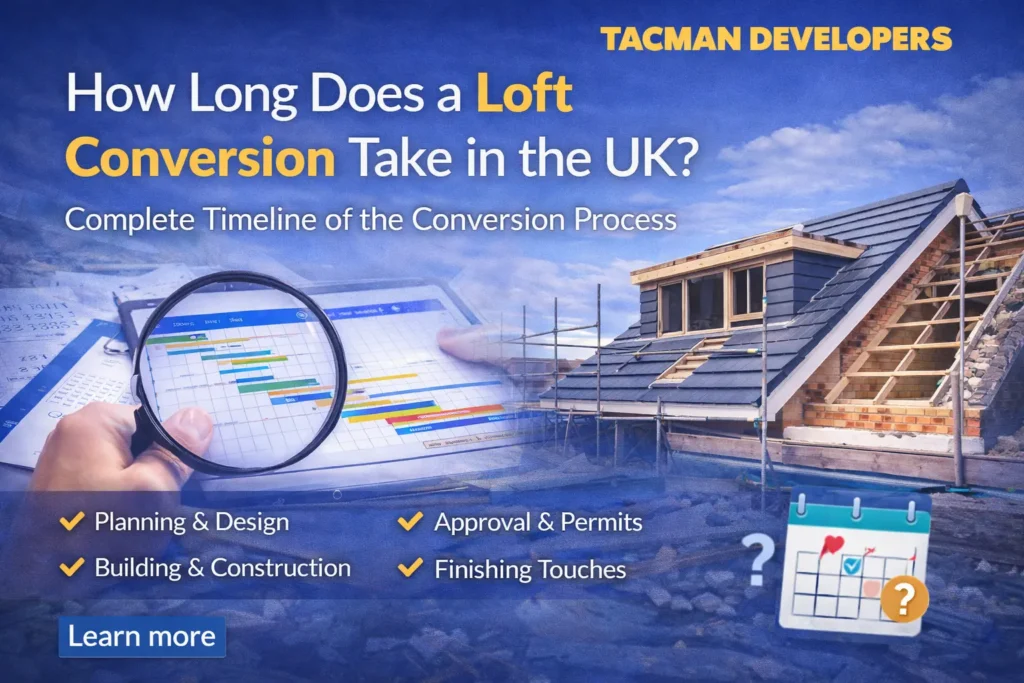
A loft conversion in the UK typically takes 6 to 12 weeks for construction, while the full process, including design, approvals, and planning, can take 2 to 4 months or longer, depending on complexity, property type, and local authority requirements.
Understanding how long a loft conversion takes is one of the most important factors when planning a home improvement project in the UK. Whether you’re a homeowner looking to create extra living space, an investor aiming to increase property value, or a family needing an additional bedroom or office, timing plays a crucial role in decision-making.
Loft conversions are widely regarded as one of the most efficient ways to expand a property without sacrificing outdoor space. In densely populated areas such as London, where moving home can be expensive and disruptive, converting unused attic space offers a practical and cost-effective solution.
However, while many guides provide rough estimates, timelines can vary significantly depending on several factors. These include the type of conversion, the property’s condition, planning permissions, and the contractor’s experience.
This comprehensive guide goes beyond basic timelines. It provides real-world insights, expert-level explanations, and practical advice based on UK construction standards. By the end, you will have a clear understanding of what to expect and how to plan your project efficiently.
How Loft Conversion Timelines Differ Across the UK
Loft conversion timelines vary across the UK due to differences in local authority approvals, property types, and urban density, with London projects often taking longer.
In the UK, not all loft conversion projects follow the same timeline, even if they appear similar on the surface. One of the key factors influencing duration is geographic location. For example, projects in London often take longer due to stricter planning controls, conservation areas, and higher demand for skilled contractors.
In contrast, properties in smaller towns or rural areas may experience faster approval times and smoother construction phases due to fewer restrictions and lower demand pressures. This variation highlights the importance of working with professionals who understand local regulations and market conditions.
For accurate regional guidance, homeowners can explore official planning insights through the Planning Portal UK, which explains how local authorities impact project timelines.
What Is the Average Loft Conversion Timeline in the UK?
Most loft conversions take 6–12 weeks for construction, but the full process, including planning and design, can take 8–16 weeks or more.
The timeline of a loft conversion is influenced by both pre-construction and construction phases. While many homeowners focus on the build time, the design and approval stages are equally important and can significantly impact the overall duration.
From a professional standpoint, experienced developers often emphasise that planning thoroughly at the beginning can save weeks during construction. This is why engaging experts early, such as through professional loft conversion services, can streamline the process and reduce delays.
Detailed Timeline Overview
| Phase | Duration |
| Design & Planning | 2–4 weeks |
| Approvals | 2–8 weeks |
| Construction | 6–12 weeks |
| Total Project Time | 8–16+ weeks |
Detailed Loft Conversion Timeline Breakdown
The loft conversion process includes design, approvals, structural preparation, construction, and finishing, each contributing to the overall timeline.
Design and Planning (2–4 Weeks)
This phase sets the foundation for the entire project. Architects assess your property, create detailed drawings, and ensure compliance with structural and regulatory requirements. Poor planning at this stage often leads to delays later, making it critical to get it right.
Working with experienced professionals offering architectural design services ensures that layouts are optimised for both functionality and compliance.
Planning Permission and Regulations (2–8 Weeks)
Although many loft conversions fall under permitted development rights, certain projects, especially in conservation areas or involving major structural changes, require planning permission.
For accurate and up-to-date guidance, homeowners should consult the Planning Portal UK, which provides official advice on planning rules and applications.
Additionally, compliance with building regulations is mandatory. These standards ensure safety, energy efficiency, and structural integrity, as outlined by the UK Government Building Regulations.
Structural Work (1–2 Weeks)
Structural preparation involves reinforcing the floor, installing steel beams, and ensuring the loft can safely support its new purpose. This stage is critical and must be completed to precise engineering standards.
Construction Phase (3–6 Weeks)
The construction phase is where the transformation becomes visible. Dormers are built, insulation is installed, windows are fitted, and internal walls are constructed.
Many homeowners take this opportunity to combine their loft conversion with broader improvements, such as home refurbishment services, to enhance the overall property.
Final Finishing and Certification (1–2 Weeks)
The final stage includes plastering, decorating, flooring, and inspections. Once approved, a completion certificate is issued, confirming compliance with all regulations.
Key Factors That Influence Loft Conversion Timelines
Timelines depend on conversion type, property condition, planning requirements, weather, and contractor expertise.
From an expert perspective, timelines are rarely fixed. Instead, they are influenced by a combination of technical and external factors. For example, older properties often require additional structural reinforcement, which can extend timelines.
Weather conditions can also play a role, particularly during roofing work. In the UK, unpredictable weather can cause short-term delays, especially in the winter months.
Another critical factor is the experience of the contractor. Skilled professionals can anticipate challenges and resolve issues quickly, while inexperienced teams may struggle, leading to delays.
How Property Type Impacts Loft Conversion Duration
Different property types, such as terraced, semi-detached, or detached homes, affect loft conversion timelines due to structural complexity and access constraints.
The structure and layout of your property play a significant role in determining how long your loft conversion will take. For instance, terraced houses, which are common in London, often require careful planning due to shared walls and limited access. This can slow down both structural work and material delivery.
Semi-detached and detached homes generally offer more flexibility, making construction faster and more straightforward. However, older properties may require additional reinforcement or upgrades to meet current building regulations.
Loft Conversion vs Other Property Projects
Loft conversions are faster than extensions and significantly quicker than new builds, making them ideal for time-sensitive projects.
Comparison Table
| Project Type | Timeline |
| Loft Conversion | 6–12 weeks |
| Extension | 10–16 weeks |
| New Build | 6–12 months |
Compared to larger projects such as home extensions or new build developments, loft conversions are relatively quick and less disruptive.
Timeline Breakdown by Loft Conversion Type (Deep Analysis)
Each loft conversion type has a different timeline, with rooflight conversions being the fastest and mansard conversions taking the longest.
While general timelines provide a useful overview, a deeper understanding of each conversion type helps set realistic expectations. Rooflight conversions are the quickest because they involve minimal structural changes, while dormer and mansard conversions require more extensive work.
| Type | Complexity | Timeline | Disruption Level |
| Velux | Low | 4–6 weeks | Low |
| Dormer | Medium | 6–10 weeks | Medium |
| Hip-to-Gable | Medium-High | 8–12 weeks | Medium |
| Mansard | High | 10–14+ weeks | High |
Choosing the right type depends not only on budget and space but also on how quickly you need the project completed. Consulting with experienced loft conversion specialists ensures you select the most suitable option.
Hidden Delays Most Homeowners Don’t Expect
Unexpected delays often come from approvals, structural surprises, material shortages, and design changes.
From real-world experience, some delays are not immediately obvious. For instance, discovering structural issues after opening the roof can add weeks to the project. Similarly, supply chain delays for materials can impact timelines.
According to the Royal Institution of Chartered Surveyors, proper planning and risk assessment are essential to avoid unexpected delays in construction projects.
Planning Permission vs Permitted Development: Timeline Impact
Projects under permitted development are faster, while those requiring planning permission can add several weeks to the timeline.
One of the biggest factors affecting your loft conversion timeline is whether your project falls under permitted development or requires full planning permission. Permitted development projects can move forward much faster, as they avoid the lengthy approval process.
However, if planning permission is required, particularly in conservation areas or for larger designs, it can add several weeks or even months to your timeline. This is especially relevant in London, where regulations are often stricter.
Expert Tips to Speed Up Your Loft Conversion
You can speed up your project by planning early, hiring experienced professionals, and avoiding design changes during construction.
From an expert standpoint, efficiency comes down to preparation and execution. Starting with a clear plan, securing approvals early, and working with experienced professionals significantly reduces delays.
It’s also important to avoid making major changes once construction has started, as this can disrupt workflow and extend timelines.
Pre-Construction Checklist to Avoid Delays
A pre-construction checklist helps ensure your loft conversion starts smoothly and avoids common delays.
Before starting your project, it’s essential to have everything in place. Many delays occur not during construction, but before it even begins, due to poor preparation.
Key Checklist
- Finalised architectural drawings
- Approved planning permission (if required)
- Confirmed budget and timeline
- Contractor availability secured
- Materials ordered in advance
Taking these steps ensures a smoother workflow and reduces the risk of unexpected interruptions.
Does a Faster Loft Conversion Affect Quality?
A faster loft conversion does not necessarily reduce quality, but rushing without proper planning can lead to poor results.
Speed and quality must be balanced carefully. While experienced contractors can complete projects efficiently, cutting corners to save time can compromise safety and durability.
High-quality loft conversions require proper structural work, compliance with building regulations, and attention to detail. According to the Royal Institution of Chartered Surveyors, maintaining quality standards is essential for long-term property value.
How Tacman Developers Ensures Faster Project Delivery
Tacman Developers uses expert planning, efficient workflows, and compliance-focused construction to deliver projects on time.
Tacman Developers brings a structured and professional approach to loft conversions, ensuring each stage is carefully managed. Their team combines design expertise with construction experience, allowing them to anticipate challenges and maintain efficient timelines.
By integrating services such as design, planning, and construction, they eliminate common bottlenecks that slow down projects. This holistic approach ensures that your loft conversion is completed on time, within budget, and to the highest standards.
Conclusion
Understanding how long a loft conversion takes is essential for planning a successful project. While the typical construction timeline ranges from 6 to 12 weeks, the full process can extend to several months when design and approvals are included.
The key to staying on schedule lies in proper planning, realistic expectations, and working with experienced professionals. A well-executed loft conversion not only adds valuable living space but also enhances the overall functionality and value of your property.
With the right approach, your loft conversion can be completed efficiently, transforming unused space into a high-quality, practical living area.
Ready to unlock the full potential of your home?
With Tacman Developers, you get expert planning, precise timelines, and high-quality construction, all tailored to UK standards. Start your loft conversion today and create a space that adds real value to your home.
FAQs
How long does a loft conversion take from start to finish?
A loft conversion typically takes 6–12 weeks for construction, but the full process, including planning, can take up to 4 months.
The timeline depends on approvals, design complexity, and property conditions.
What is the quickest loft conversion option?
Velux conversions are the fastest as they require minimal structural changes.
They can usually be completed within 4–6 weeks.
Can bad weather delay a loft conversion?
Yes, the weather can affect roofing and external construction work.
However, experienced builders plan around weather conditions to minimise delays.
Is planning permission always required?
No, many loft conversions fall under permitted development rights.
However, larger or more complex designs may require approval.
Can I combine a loft conversion with other projects?
Yes, many homeowners combine conversions with refurbishments or extensions.
This can maximise value but may increase the overall timeline.