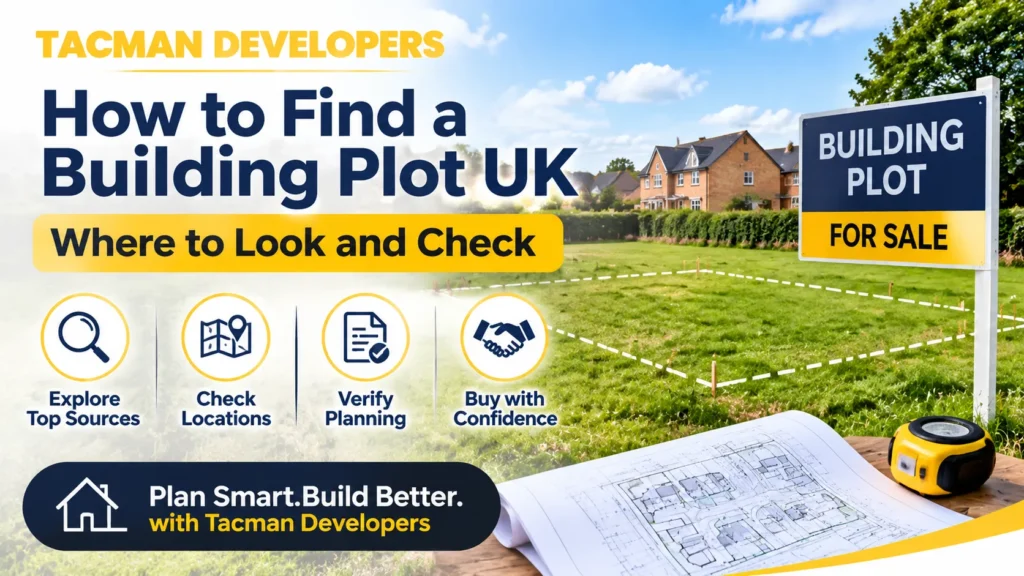
Knowing how to find a building plot is the first step to building your own home. You can search property websites, ask land agents, join your council’s self-build register and look at auctions. But finding a plot is the easy part. The real work is checking whether you can actually build on it.
A cheap plot with no planning permission, no road access or a flood problem can cost you far more than a dearer plot that is ready to go. So this guide covers both parts: where to look, and what to check before you pay.
At Tacman Developers, we have worked in design and build for more than 35 years. We help people turn land into homes, and we have seen what makes a plot a good buy or a costly mistake. You can read more about our new build service.
What Counts as a Building Plot?
A building plot is a piece of land where you could build a home. It might be:
- A gap between two houses, known as an infill plot
- A large garden that has been split off
- An old house you plan to knock down and replace
- A farm building or yard
- A piece of empty land on the edge of a village
Some plots already have planning permission. Others do not. That difference changes the price and the risk, so keep it in mind as you search.
Where to Look for a Building Plot
No single place has every plot. Most buyers use several of these at once.
Property websites
Rightmove and Zoopla both have land and plot sections. Use the “land” filter and search wide areas. Set up email alerts, because good plots can sell fast.
Specialist plot websites
Some websites list only plots and self-build land. They often show whether planning permission is in place, which saves time.
Local estate agents and land agents
Many plots never reach the big websites. Local agents hear first. Ring a few firms in your chosen area and tell them what you want. A short, clear brief works best, such as the size of plot, budget and areas.
Auctions
Auction houses often sell land. Prices can be low, but you usually pay within weeks, and you have little time to check things. Do all your checks before the auction day, not after.
Your council’s Right to Build register
In England, councils must keep a register of people who want to build their own home. They must also grant planning permission, or permission in principle, for enough serviced plots to meet that demand within three years. Joining is usually free or cheap, and you can sign up with more than one council. There is no promise of a plot that matches your wishes, but it helps. Homebuilding & Renovating has a clear guide to the Right to Build.
Knock down and rebuild
You may find a tired house on a good plot. Buying it, taking it down and building new is a popular route. It is also a way to land in a place where empty plots are rare.
Gardens, farms and word of mouth
Look for big gardens, old garages, farm yards and unused land. Ask the owner if they would sell, or talk to neighbours and local builders. It takes time, but some of the best plots come this way.
What to Check Before You Buy a Plot
This is the part that saves money. Go through each of these before you make an offer, or make your offer conditional on them.
1. Planning permission
Check the status clearly. A plot can have:
- Full planning permission. The design is approved, and you can build it or ask to change it.
- Outline planning permission. The principle is agreed, but you must still apply for the details.
- No planning permission. It is a gamble. The land may be cheap for a reason.
Look at the dates too. Permission does not last forever. Ask what conditions are attached, because some need work or paperwork before you can start.
You can see past planning applications on the council’s website. Also check if neighbours objected, and why.
2. Access
You need a legal way in. Ask who owns the road or track. Check if you have the right to use it, and whether the width is enough for builders’ lorries and, later, fire engines. A plot behind another house, down a private lane, needs extra care.
3. Services
Find out if the plot has, or can get:
- Mains water
- Electricity
- Drainage or sewers
- Gas, if you want it
- Broadband
Connecting to services can cost thousands, especially if the pipes are far away. Ask the utility companies for quotes early.
4. Ground and trees
Poor ground can mean deep foundations, which cost more. A soil report, also called a ground investigation, will tell you. Look for signs of old fill, soft clay, a high water table or old buildings.
Trees matter too. Some are protected by Tree Preservation Orders, and roots can affect the foundations. Do not assume you can remove a tree.
5. Flood risk
Check the GOV.UK long term flood risk service for the plot. It covers rivers, the sea, surface water and more. If there is any flood risk, planners may ask for a flood risk assessment, and insurance and mortgages can be harder.
6. Ownership, covenants and rights of way
Ask your solicitor to check the title. Look for:
- Restrictive covenants, which may limit what you can build
- Rights of way across the land
- Boundary disputes
- Who owns the land, and whether they can legally sell it
A covenant can stop your plan, even when planning permission is granted.
7. Wildlife and the environment
Bats, newts, badgers and nesting birds are protected. Old barns, hedges and ponds often hold wildlife. A survey may be needed, and some can only be done at certain times of year. That can delay your start.
8. Neighbours and past use
Visit at different times of day and talk to neighbours early. Also ask what the land was used for before. Land with an industrial past may be polluted, and cleaning it up costs money.
Check the Numbers Before You Commit
A plot is only part of the cost. Add up:
- The price of the land
- Legal fees and stamp duty
- Design and planning fees
- Service connections
- Ground work and foundations
- The build itself
- Landscaping and driveway
- A spare amount of 10% to 15% for surprises
A plot that looks cheap can become dear once all these are added. Ask a builder or designer for a rough view of the full cost before you buy.
VAT on a self-build
If you build a new home for yourself using a contractor, the work is often zero-rated for VAT. If you use the DIY housebuilders route, you can claim back VAT on materials. GOV.UK says that for buildings completed on or after 5 December 2023, you must claim within 6 months of completion. You need your planning permission papers, plans and Building Regulations completion certificate. Read the HMRC DIY housebuilder guidance and ask an accountant to check your own case.
Community Infrastructure Levy
Some councils charge a levy on new homes. A self-build exemption may apply, but councils have their own rules and you often must apply before work starts. Ask your council first.
Get Advice Before You Pay
The best time to ask for help is before you buy, not after. A designer or builder can look at a plot and tell you:
- If the size works for the home you want
- What planning risks to expect
- Rough costs for ground work and services
- Whether your budget fits
Our design services can help you understand planning and what is possible on a site. It is much cheaper to learn that a plot has problems before you buy it.
Choosing How You Will Build
Once you own a plot, you must decide how to manage the build. There are two common routes.
With a traditional contract, you hire a designer first and then builders bid for the work. With design and build, one company looks after the design, planning and construction. Each has pros and cons. Our guide on design and build vs traditional contracts explains which suits which type of project.
Plan Your Home Before the Build Begins
Think about the inside early too. Where will the sun fall? How will you use each room? Where do you want large windows and storage? Layout and finish choices are easier to plan before walls go up. Our guide to interior design trends in the UK for 2026 can give you ideas.
Why Work with Tacman Developers?
We design and build, so one team can look at your plot, plan the home and build it. Tacman Developers Ltd is registered in England (company number 15303945). We offer UK wide construction, and we give itemised estimates based on your agreed design before work starts.
[ADD: one or two real details from your own new-build or plot projects, such as a plot you helped check before purchase, and what the survey found.]
Conclusion
Learning how to find a building plot is a mix of searching and checking. Use property websites, agents, auctions, your council register and your own local contacts. Then check planning, access, services, ground, flood risk, ownership and wildlife before you pay.
The cheapest plot is not always the best value. The best plot is the one where you can build the home you want, at a cost you can afford. If you would like help judging a plot, contact the Tacman Developers. We will look at the site with you and explain what to expect.
Frequently Asked Questions
How do I find a building plot near me?
Search Rightmove, Zoopla and plot websites, ring local land agents, check auctions and join your council’s self-build register. Also ask neighbours, as some plots never get advertised.
Is it better to buy a plot with planning permission?
Usually it is safer, because the main risk is gone. It often costs more. A plot without permission can be cheaper but carries a real risk that you cannot build.
What is the Right to Build?
It is a law in England that makes councils keep a register of people who want to build their own home. Councils must then grant permission for enough serviced plots to meet that demand.
What should I check before buying a plot of land?
Check planning status, access, services, ground, flood risk, trees, covenants, wildlife and ownership. Get a solicitor to check the title.
Can I reclaim VAT on a self-build?
Often yes, through the DIY housebuilders scheme. For buildings completed on or after 5 December 2023, you must claim within 6 months of completion.
Do I need planning permission to build a house on a plot?
Yes. New homes normally need planning permission. That can be full permission, or outline permission followed by approval of the details.
How much does a building plot cost?
It varies hugely by area, size and planning status. A plot with permission in a high-demand area costs far more than rural land with none.